Joe Nickell, a well-known “skeptic” and investigator of claims of the unknown, was born December 1, 1944, in West Liberty, Kentucky. He died at 8o years of age on March 4, 2025.
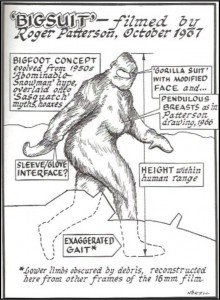
The research for Tracking the Man-Beasts: Sasquatch, Vampires, Zombies, and More took Nickell to many locations of reported monster sightings—the Pacific Northwest for Bigfoot, Australia for the Yowie, Austria for werewolves, New England for vampires, Argentina for the Chupacabras, West Virginia for aliens, and Louisiana for the swamp creatures. Nickell traces the monsters’ iconography from first reports to latest sightings, concluding that the tales reflect the evolution of their cultural environment, not any basis in fact. A quote from his guide in the Louisiana swamps provides insight into the genesis of the tales, “… frightening tales could sometimes have been concocted to keep outsiders away—to safeguard prime hunting territory or even possibly to help protect moonshine stills. Charbonnet also suggested that such stories served in a bogyman fashion, frightening children so they would keep away from dangerous areas.” ~ Ed Grabianowski.
Nickell was a senior research fellow for the Committee for Skeptical Inquiry and wrote regularly for their journal, Skeptical Inquirer. He was also an associate dean of the Center for Inquiry Institute. He was the author or editor of over 30 books.
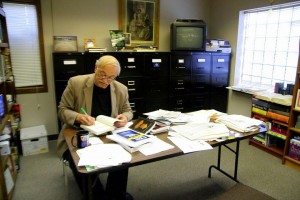
Joe Nickell’s books were so wide-ranging that he overlapped into cryptozoology sometimes.
For example…beside the mystery hominids, he also tackled:
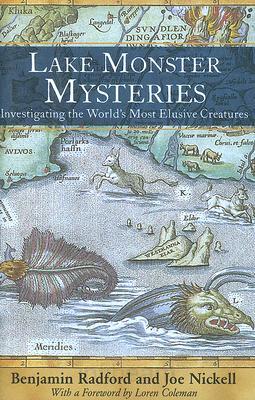
Lake Monster Mysteries: Investigating the World’s Most Elusive Creatures is a collaboration of Nickell and Ben Radford, with a foreword by Loren Coleman. Author Ed Grabianowski summarizes one of the many possible explanations for lake monster sightings,
… a convincing argument based, again, on data mapping. He plotted the distribution of North American lake monster sightings. Then he overlaid the distribution of the common otter and found a near perfect match. It turns out that three or four otters swimming in a line look remarkably like a serpentine, humped creature undulating through the water. It is very easy to mistake for a single creature if you see them from a distance. “This isn’t speculation. I’m not making this up,” Nickell said. “I’ve spoken to people who saw what they thought was a lake monster, got closer and discovered it was actually a line of otters. That really happens.” Clearly, not every lake monster sighting can be accounted for with otters, but it’s an excellent example of how our perceptions can be fooled.
In Point Pleasant, West Virginia, March 18-20, 2011, to do a TV shoot regarding the town’s most famously spooky denizen—Mothman—I was pleased to finally meet in person Loren Coleman who was also flown in for the show.
Coleman has written on a number of paranormal or otherwise “strange” enigmas—witness his 2001 Mysterious America, for example. He is best known, however, as a cryptozoologist, that is, one who studies unknown or “hidden” creatures—i.e., “cryptids,” such as Bigfoot. His numerous books include Cryptozoology A to Z (1999, co-author Jerome Clark), Mothman and Other Curious Encounters (2002), and Bigfoot! The True Story of Apes in America (2003). He is in fact, one of the world’s best-known cryptozoologists. He maintains a blog site called Cryptomundo (https://www.cryptomundo.com) and, in Portland, Maine, his International Cryptozoology Museum (occupying the rear of the shop The Green Hand, which specializes in weird fiction).
As we sat talking in the lobby of the “haunted” Lowe Hotel (the subject of a forthcoming blog), I told him lightheartedly that I regarded him as “the best of a bad lot.” As he laughed, and as I went on to suggest he would perhaps say the same of me, I explained: Just as I reject the pejorative “debunker” that is often applied to me, I know he decries the label “believer” being pasted onto him. Rather, we are both field investigators and scholars (he has studied zoology and anthropology and has a master’s in social work), and, while we may find ourselves on opposite sides of the fence, we therefore may have more in common with each other than with some persons in our own respective camps.
(Indeed, I now apply the term cryptozoologist to myself, albeit usually adding the adjective skeptical to clarify my orientation. Those who are purely True Believers or dismissive debunkers—who avoid the scholarly approach implied by the suffix ology (from the Greek logos, “description,” indicating a branch of learning)—clearly do not earn the appellation.)
Coleman and I had crossed paths several times before. He was kind enough to write a foreword to my Lake Monster Mysteries: Investigating the World’s Most Elusive Creatures(2006, co-author Ben Radford). And on CNN we briefly debated a film clip of a lake “monster” which I suggested (due in part to its fast, undulating locomotion) was a large European otter, Lutra lutra. Loren responded with a blog titled “Otter nonsense,” caricaturing my position, and I replied in kind, saying “he otter do better.” All in good fun, despite the seriousness of the debate. (See my “The Loch Ness Critter,” Skeptical Inquirer, Sept./Oct. 2007).
And there we have it, I think: two fellows with much of life in common—one chiding his own colleagues to be more skeptical, the other urging his to do more listening. Well met.
April 12, 2011 ~Joe Nickell
It will be recalled in the otter competitive battle between the forces of good and evil, the following war near the water (versus a rumble in the jungle) occurred on CNN’s “Paula Zahn Now,” for June 1, 2007. The topic was a new video allegedly showing Nessie, which was run in the final moments of her program. It was originally scheduled to be five minutes long, but Joe Nickell and I were cut short by an earlier story, as is often the case.
At the time, my old coauthor buddy Jerry Clark noted that what was operating here, in counterpoint to my view, was: The Nickell principle: “We will take up an existence by its otters.”
Coincidentially, another good friend, Anomalist Books publisher Patrick Huyghe emailed me: “Joe was otterly ridiculous.”
Hey, what are friends for, if not to support one another with an otter side of humor, humm?
Now, fast forward to 2009. The splashy sumo wrestling continues regarding the new Lake Champlain footage.
“Joe Nickell, a cryptozoologist in Amherst, N.Y., says his best guess is that the object was a moose calf.” ~ NECN
What is amusing is that, regarding the new Eric Olsen “Champ video,” Nickell has now been quoted, not as a skeptic, but as a “cryptozoologist” by the Associated Press. He allegedly told NECN/AP that the new Lake Champlain footage looks like a “young moose.”
Meanwhile, I have been correctly characterized as a “cryptozoologist” by the media, but sometimes my careful and skeptical cryptozoological approach to this new video ~ even considering it might be an otter or a super-otter ~ have been ignored by reporters.
Needless to say, the media enjoy quoting my cryptozoologist point-of-view to counterbalance the skeptic’s broadly debunking approach. I’d even wage that Joe Nickell (a “moose calf”) and Ben Radford (he’s now appeared claiming the animal in the 2009 video is “an elk* or deer in the water”) occupy a position closer to the middle than reported in the media. Maybe not, but I think they might. Likewise people are missing that I have also stated and do consider,
1) this is, first and foremost, an interesting piece of footage that deserves further investigation;
2) I know moose, deer, and dogs, in the water and out, and the absence of ears does seem to indicate this animate object is not one of them;
3) this could be a misidentified otter, beaver, muskrat, turtle**, or out-of-place harbor seal (as I have writtenbefore, there are records for Lake Champlain of a few seals appearing there); or
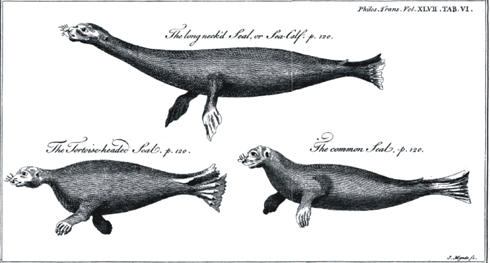
4) it could just be and might have to remain a “lake cryptid” (Darren Naish’s Long-Necked Seal? Heuvelman’s Super-Otter? Coleman-Huyghe’s Waterhorse?) because we will never be able to definitively identify this animal from the cellphone camera footage.
5) Therefore, I remain open-minded, and, yes, enthusiastic in my typical cryptozoological fashion (hey, I know myself) about continuing an ongoing look at this footage to see if more can be “seen” and learned from it.
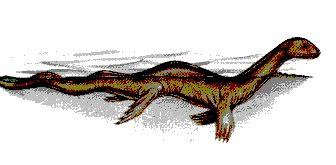
Bernard Heuvelmans’ Super-Otter:
I coauthored Cryptozoology A to Z (NY: Simon and Schuster) with Jerome Clark in 1999.
The research for Tracking the Man-Beasts: Sasquatch, Vampires, Zombies, and More took Nickell to many locations of reported monster sightings—the Pacific Northwest for Bigfoot, Australia for the Yowie, Austria for werewolves, New England for vampires, Argentina for the Chupacabra, West Virginia for aliens, and Louisiana for the swamp creatures. Nickell traces the monsters’ iconography from first reports to latest sightings, concluding that the tales reflect the evolution of their cultural environment, not any basis in fact. A quote from his guide in the Louisiana swamps provides insight into the genesis of the tales, “… frightening tales could sometimes have been concocted to keep outsiders away—to safeguard prime hunting territory or even possibly to help protect moonshine stills. Charbonnet also suggested that such stories served in a bogyman fashion, frightening children so they would keep away from dangerous areas.”
Although Nickell rejected the term “debunker” to describe his work, his evidenced-based investigations of paranormal events did not uncover any miracles, ghosts or monsters.
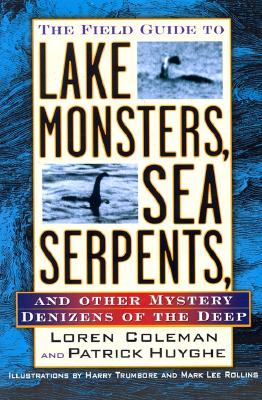
I coauthored The Field Guide to Lake Monsters, Sea Serpents, and Other Mystery Denizens of the Deep (NY: Tarcher/Penguin) with Patrick Huyghe in 2003.
I wrote the Foreword to Lake Monster Mysteries: Investigating the World’s Most Elusive Creatures by Benjamin Radford and Joe Nickell, published in 2006 by the University Press of Kentucky.
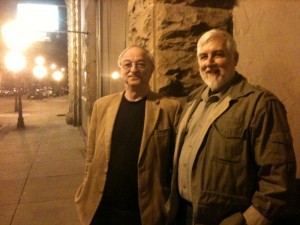
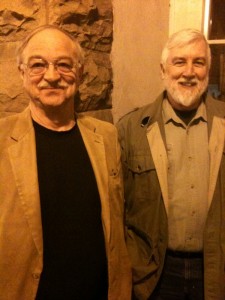

Magic trick revealed: I pulled a fast one on Joe. After noting that he was going to be much taller in photos, I jumped up on a step on Point Pleasant’s Main Street to “equalize” the framing of the imagery (above). With the coloring of the street lamps, I think they came out rather well.
Follow CryptoZooNews
Not Found
The resource could not be found.