Cryptozoologists of the Year 2025: Red Wolf Researchers
by Loren Coleman, Director, International Cryptozoology Museum.
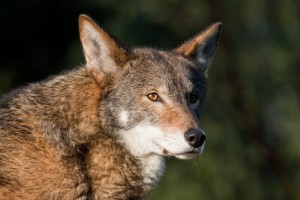
Cryptozoology is the “study of hidden animals.” For 2025, the International Cryptozoology Museum bestows it annual “Cryptozoologist of the Year” awards, the Golden Yetis, on two biologists who were able to “find” the “ghost red wolves.” These canids were hiding in plain sight, in the ghost alleles of red wolves.
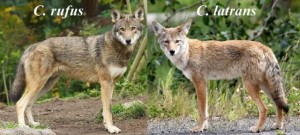
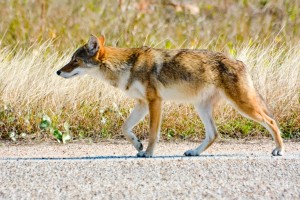
Here is the nearly pure “red wolf” (on the left) compared to a coyote.

“We need resilient wildlife to maintain species on the landscape. We might not be successful, but we’re going to try. It’s worth trying.” — said Kristin Brzeski, associate professor of wildlife science and conservation.
According to a New York Times article in 2022:
A population of strange canids in Texas could hold the key to reviving the highly endangered red wolf. From a distance, the canids of Galveston Island, Texas, look almost like coyotes, prowling around the beach at night, eyes gleaming in the dark.
But look closer and oddities appear. The animals’ bodies seem slightly out of proportion, with overly long legs, unusually broad heads and sharply pointed snouts. And then there is their fur, distinctly reddish in hue, with white patches on their muzzles.
The Galveston Island canids are not conventional coyotes — at least, not entirely. They carry a ghostly genetic legacy: DNA from red wolves, which were declared extinct in the wild in 1980….
“ “It doesn’t seem to be lost any longer,’ said Bridgett vonHoldt, an evolutionary biologist at Princeton University, referring to the genetic diversity that once characterized red wolves. ‘We might have a chance to bring it back.’


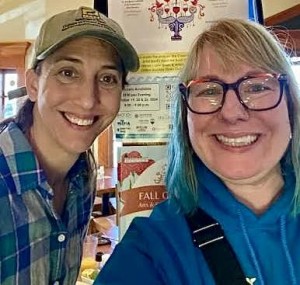
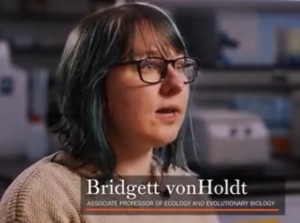
Bridgett M. vonHoldt, Ph.D.
Bridgett M. vonHoldt is Associate Professor of Ecology & Evolutionary Biology at Princeton University. She received a B.S. in Psychology, Eckerd College (2002), an M.S. in Biology, New York University (2004), and a Ph.D. in Ecology & Evolutionary Biology, University of California, Los Angeles (2010). She was a post-doctoral scholar at UC Irvine in Evolution and Epigenetics and at UCLA in Epigenomics and Bioinformatics. She studies evolutionary genomics, ancestry inference, domestication, canid evolution, regulatory variation, genomics, and conservation genomics. Memberships include Dog10K Genomes Consortium, Red Wolf Workshop, American Genetic Association, and the Morris Animal Foundation Wildlife Scientific Advisory Board. Her research focuses on evolutionary genomics of admixed species, hybrid zones, and consequence of natural selection on the regulatory genome. She has carried out extensive studies on wild and domesticated canines. Her research has significant conservation applications for endangered species like the red wolf and gray wolf of North America.
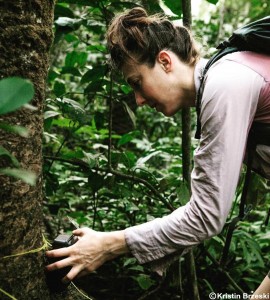

Kristin Brzeski, Ph.D.
Kristin Brzeski is a conservation geneticist who conducts research at the intersection of applied conservation and wildlife ecology. As an assistant professor at Michigan Technological University, she uses genomic and epigenetic sequencing, noninvasive genetics, and a variety of field-based techniques to unravel the ecology of little-known species and protect endangered wildlife. With a primary focus on wild canid genetics, Kristin has made significant contributions in her field as director of the Gulf Coast Canine Project and contributor to the Canine Ancestry Project. In addition to her canid research, Kristin is a co-founder of Biodiversity Initiative, an NGO focused on the protection of biodiversity in Central Africa through the collaborative creation, study, and management of protected areas.
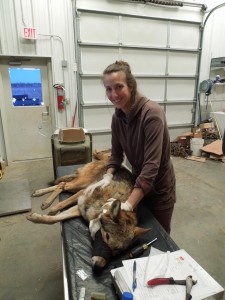
The Recovery of the “Red Ghost Wolf” (click to see video).
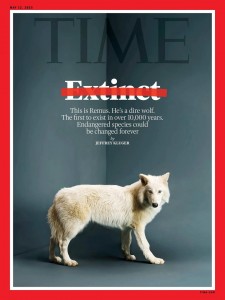
While the recent “dire wolf” story captured the headlines, these two individuals’ work is hidden in the 2024 TIME magazine cover story for the groundbreaking leaps they completed to help save one of the most endangered species in the U.S., the red wolf.
+++++
[Special thanks for the suggestion this year goes to Christopher Packard, (who earned his second Masters in Biology in 2025, with research on the Maine recovery of wolves) and is Assistant Director of the International Cryptozoology Museum (which moving to Bangor, Maine, in 2026).]
++++Also++++
2025
Cryptozoologists of the Year: Posthumous Hominologists
by Loren Coleman, Director, International Cryptozoology Museum
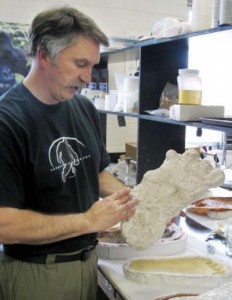
Jeff Meldrum, Ph.D., anthropologist, author, Sasquatch: Legend Meets Science (2006)
(May 24, 1958 – September 9, 2025)
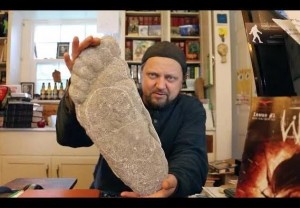
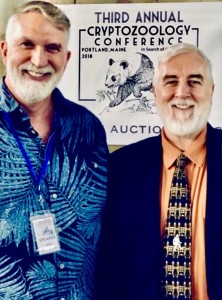
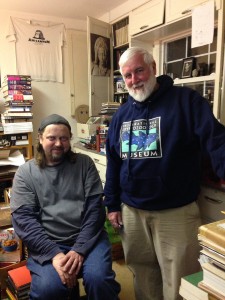
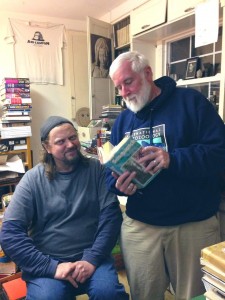
Steven Streufert, owner/founder, Bigfoot Books
(December 19, 1964 ~ December 9, 2025)
We are sorry to have lost these two Bigfoot scholars.
Join the International Cryptozoology Museum to support the work we are continuing to conduct. Click here.
Thank you.
For the complete list of past honorees, see “Cryptozoologists of the Years (2008~2025).”
Follow CryptoZooNews
Not Found
The resource could not be found.