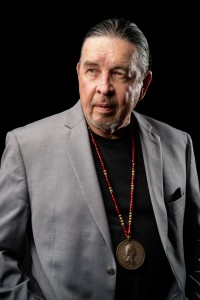
Harvey Phillip Pratt (April 13, 1941 – December 2025) was an American forensic artist and Native American artist, who worked for over 40 years in law enforcement, completing thousands of composite drawings and hundreds of soft tissue postmortem reconstructio
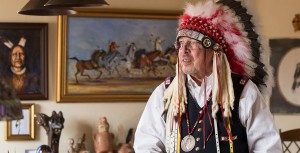
Pratt was born in El Reno, Oklahoma on April 13, 1941, and was a member of the Cheyenne and Arapaho tribes where he was recognized as one of the traditional Cheyenne Peace Chiefs, also known as the Council of Forty-Four. He was recognized by the Cheyenne People as an Outstanding Southern Cheyenne. Pratt was the great-grandson of scout, guide, interpreter and Sand Creek massacre survivor, Edmund Guerrier. He was the great-great-grandson of American frontiersman, William Bent. Pratt lived in Guthrie, Oklahoma. On December 31, 2025, it was announced that he had died at the age of 84.
Bigfoot Forensic Investigations
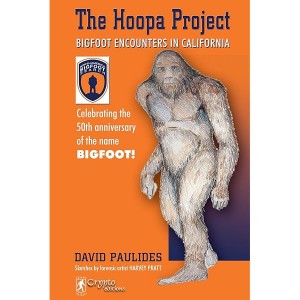
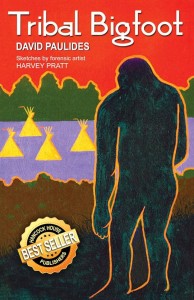
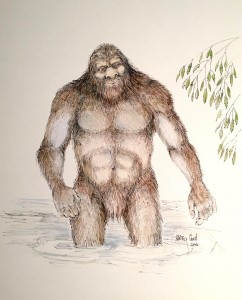
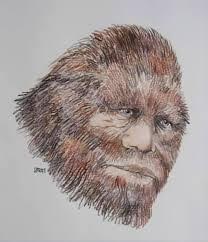
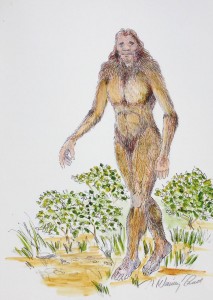
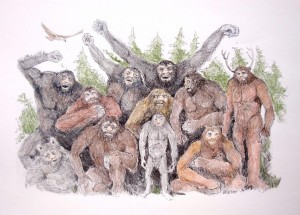
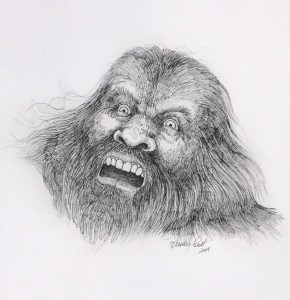
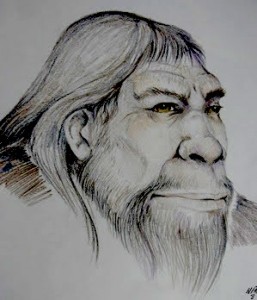
Pratt provided forensic artwork for David Paulides in the books Tribal Bigfoot and The Hoopa Project. Through extensive research, interviews, and travels, Pratt produced dozens of forensic sketches from witnesses that David Paulides and he met in California and his home state of Oklahoma.
Police Work
Pratt began his career with Oklahoma’s Midwest City Police Department in 1965, where, as a police officer, he completed his first composite drawing that resulted in an arrest and conviction. He joined the Oklahoma State Bureau of Investigation in 1972 as a narcotics investigator and retired in 1992 as an assistant director. He is now employed with the agency as a full-time forensic specialist.
Pratt’s forensic expertise has contributed to many high-profile cases: The Green River Killer (Gary Ridgway), Oklahoma Girl Scout Murders (Gene Leroy Hart), Henry Lee Lucas and Ottis Toole, Bobby Joe Long, The I-5 Killer (Randall Woodfield), Tommy Ward and Karl Fontenot, Tommy Lynn Sells, World Trade Center 1993 bombings, Ted Bundy, Sirloin Stockade Murders (Roger Dale Stafford, Verna Stafford and Harold Stafford), Joe Fischer, Roger Wheeler murder, the Oklahom
In the mid-1980s, Pratt developed the soft tissue postmortem drawing method. Using this method, the forensic artist drew or painted on the photograph of a victim to repair tissue damage or decomposition. The drawing repaired the trauma to the victim so that the final image will be more presentable when asking for law enforcement’s or the public’s assistance in identification.
Pratt encompassed painting, sculpting, wood carving, mural painting, bronze work, architectural design and graphic design. He was a self-taught artist and created in the media of oil, acrylic, watercolor, metal, clay and wood. His artwork was a blend of his forensic art and law enforcement experience with traditional Native American environment.
Pratt received awards for his artwork at Inter-Tribal Indian Ceremonials, Gallup, New Mexico, and Red Earth Festival, Oklahoma City, Oklahoma. In 2005, he was given the title “Master Artist” by Red Earth, as well as being selected as the Red Earth 2005 Honored One.
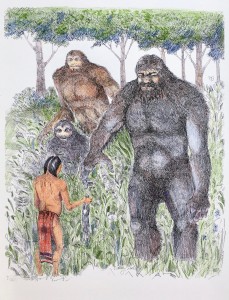
The Gift by Harvey Pratt
International Cryptozoology Museum, Bangor, Maine
His works are in many permanent collections, including the National Park Service, the Smithsonian Institution, the Sequoyah National Research Center, the University of Oklahoma, and the International Cryptozoology Museum. He accepted state appointments to the Oklahoma Arts Council by Governor Frank Keating and Governor Brad Henry.
The Smithsonian’s National Museum of the American Indian chose Pratt’s Warriors’ Circle of Honor, a 12-foot tall, stainless-steel circle balanced on a curved stone drum as the centerpiece of the National Native American Veterans Memorial. The memorial was installed outside the museum in 2020, but the official in-person dedication ceremonies did not take place until Veterans Day Weekend of 2022 because of the pandemic.
Follow CryptoZooNews
Not Found
The resource could not be found.